
Why Teaching Your Dog to Stay Could Save Their Life
Teach dog to stay effectively with this proven method: Start by asking your dog to sit or lie down, say “stay” with a clear hand signal (flat palm facing them), reward immediately before they move, and gradually increase duration to 10 seconds before adding distance or distractions. Always return to your dog to release them with a word like “okay” rather than calling them out of position.
Quick Training Steps:
- Begin with duration – Hold the stay for 1-2 seconds, reward, release
- Build to 30+ seconds – Gradually increase time before rewarding
- Add distance slowly – Take one step back, return to reward
- Introduce distractions – Start small (clapping hands) and build up
- Practice everywhere – New locations require starting from step one
The stay command isn’t just about obedience—it can literally be a lifesaver. A solid stay can prevent your dog from racing into the street, rushing out an open door, or approaching something dangerous. Beyond safety, it’s the foundation for good manners, household obedience, and impulse control that makes living with your dog more enjoyable.
Many dog owners feel frustrated when their dog won’t hold a stay, breaks position constantly, or seems to forget the command entirely when distractions appear. You’re not alone in this challenge. Stay is actually boring for dogs, which makes it one of the harder commands to master—but that’s exactly why the right training approach matters so much.
Teaching stay requires patience, consistency, and understanding the three core elements that make it work: duration (how long), distance (how far away you can be), and distraction (what’s happening around them). Work on these separately at first, building each skill before combining them.
I’m Stephen Sovenyhazy, and while my primary expertise is in digital strategy and platform engineering, I’ve worked extensively with service-based businesses like Sit Means Sit Murfreesboro to help communicate effective training methodologies that transform frustrated dog owners into confident handlers. Teach dog to stay using the proven methods outlined in this guide, developed by professional trainers who understand both canine behavior and practical real-world application.
Stay vs. Wait: Understanding the Difference
In our training sessions across Murfreesboro and Rutherford County, one of the most common questions we hear is: “What’s the difference between ‘stay’ and ‘wait’?” While they might seem interchangeable, they serve very different purposes in a dog’s mind.
A stay command is an absolute. It means “do not move from this exact spot and this exact position (sit, down, or stand) until I specifically release you.” When we teach dog to stay, we are teaching them that the behavior only ends when we give the release cue. It’s a high-stakes command used for safety and formal obedience.
On the other hand, a wait command is a temporary pause. It’s less formal and doesn’t usually require a specific body position. We use “wait” when we want a dog to pause before hopping out of the car, or to hold back for a second while we put their food bowl down. The “wait” is usually followed by another command or an invitation to move forward (like “go get it” or “let’s go”).
| Feature | Stay Command | Wait Command |
|---|---|---|
| Meaning | Hold position/place until released | Temporary pause before continuing |
| Position | Must remain in sit, down, or stand | Any position is usually fine |
| Handler Action | Handler usually returns to the dog | Handler usually calls dog forward |
| Release Cue | Mandatory specific word (e.g., “Okay”) | Often implied by the next action |
| Best Use | Safety (street), Grooming, Vet visits | Doorways, Mealtimes, Car exits |
To see these differences in action, check out this video on how to teach your dog “stay”. Understanding this distinction helps prevent confusion. If you use both words for the same thing, your dog won’t know if they’re supposed to stay put or just wait for a second. Consistency is key!
Prerequisites and Preparation to Teach Dog to Stay
Before you dive into the “stay” command, your dog needs a solid foundation. You wouldn’t try to teach a toddler to run before they can stand, right? The same logic applies here.
The Foundation Commands
To teach dog to stay, your pup must already be well-practiced at the sit and down commands. Since “stay” is an extension of these positions, your dog needs to be comfortable holding a sit or a lie-down for at least a few seconds without getting fidgety. If they are still struggling to sit on command, spend a few days brushing up on that first. You can refer to our new-puppy-checklist for other foundational skills.
The Right Environment
Start in a quiet, familiar space—like your living room in Christiana or your kitchen in Smyrna—where there are zero distractions. No squirrels, no bouncing balls, and no kids running around. We want your dog to win, and they can’t win if they’re distracted by the smell of dinner or the sound of the mailman.
High-Value Rewards
“Stay” is mentally taxing for dogs because it requires immense impulse control. To make it worth their while, use small, savory dog treats. We’re talking high-value stuff: tiny pieces of chicken, cheese, or specialized training treats. The goal is to make the “stay” more rewarding than the urge to move.
Step-by-Step Guide to a Reliable Stay
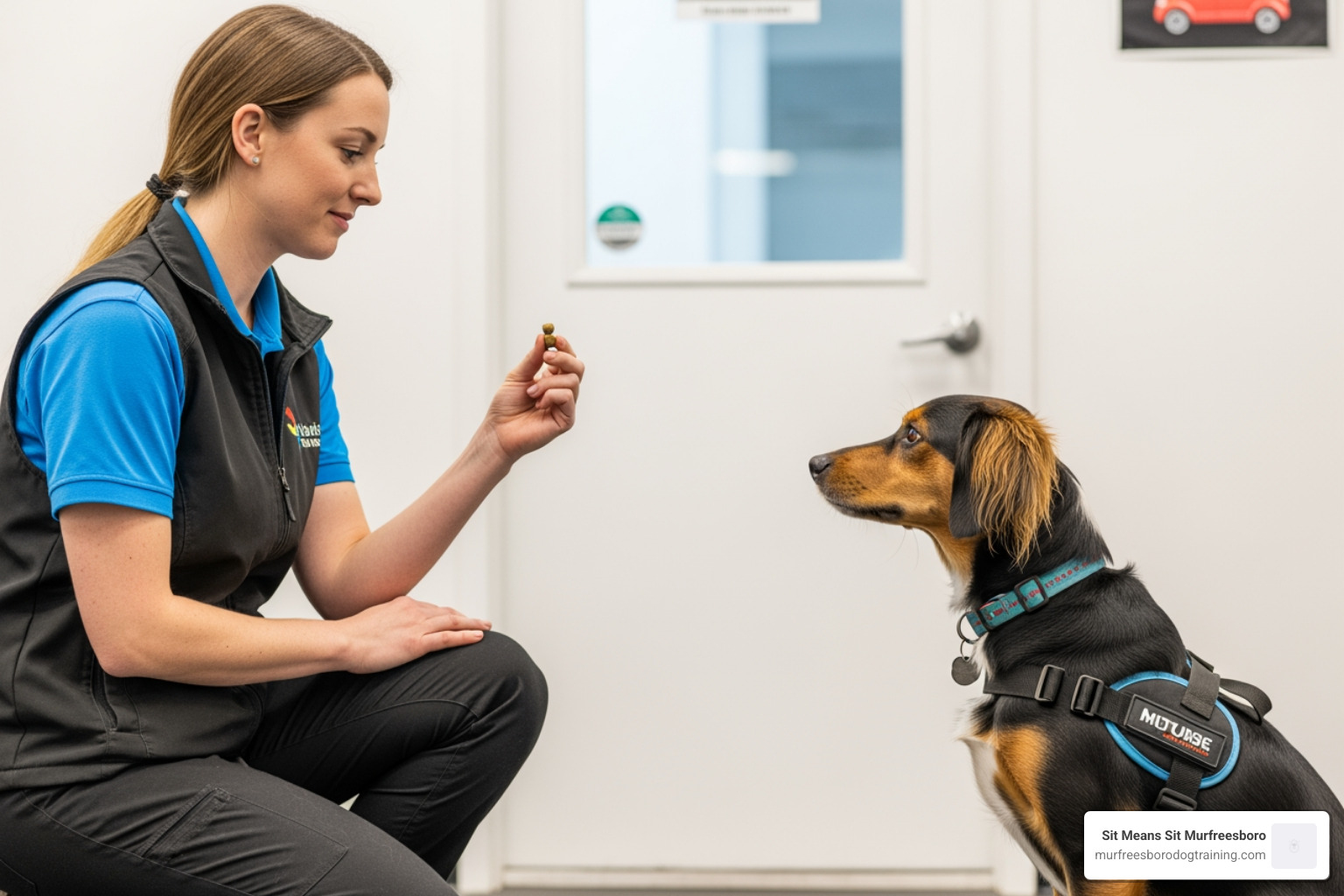
Now that you’re prepared, let’s get into the mechanics. When we teach dog to stay, we use a combination of a verbal cue and a hand signal. This provides clear communication for your dog, whether they are looking at you or just listening.
Initial Steps to Teach Dog to Stay
- The Setup: Ask your dog to sit or lie down. Ensure they are calm and paying attention to you.
- The Cue: Hold your hand straight out in front of you, palm flat and facing the dog (like a stop sign). Say the word “Stay” in a calm, firm voice.
- The Immediate Reward: In the very beginning, don’t even take a step back. Wait just one or two seconds while they remain still. Give them a treat while they are still in the position. This is crucial—we are rewarding the act of staying, not the act of getting up!
- The Release: Use a consistent release word like “Okay,” “Free,” or “Break.” Encourage them to move once you’ve said it. This tells the dog, “The job is done; you can relax now.”
- Repeat: Do this several times. Gradually wait 3 seconds, then 5 seconds, always rewarding while they are still.
If your dog pops up before you give the reward, don’t worry! It just means you moved too fast. Simply reset them by asking for a sit again, and try for a shorter duration. For more on what to expect during this process, read about professional-dog-training-in-murfreesboro-tn-what-local-dog-owners-should-expect.
Using the Three Ds to Teach Dog to Stay
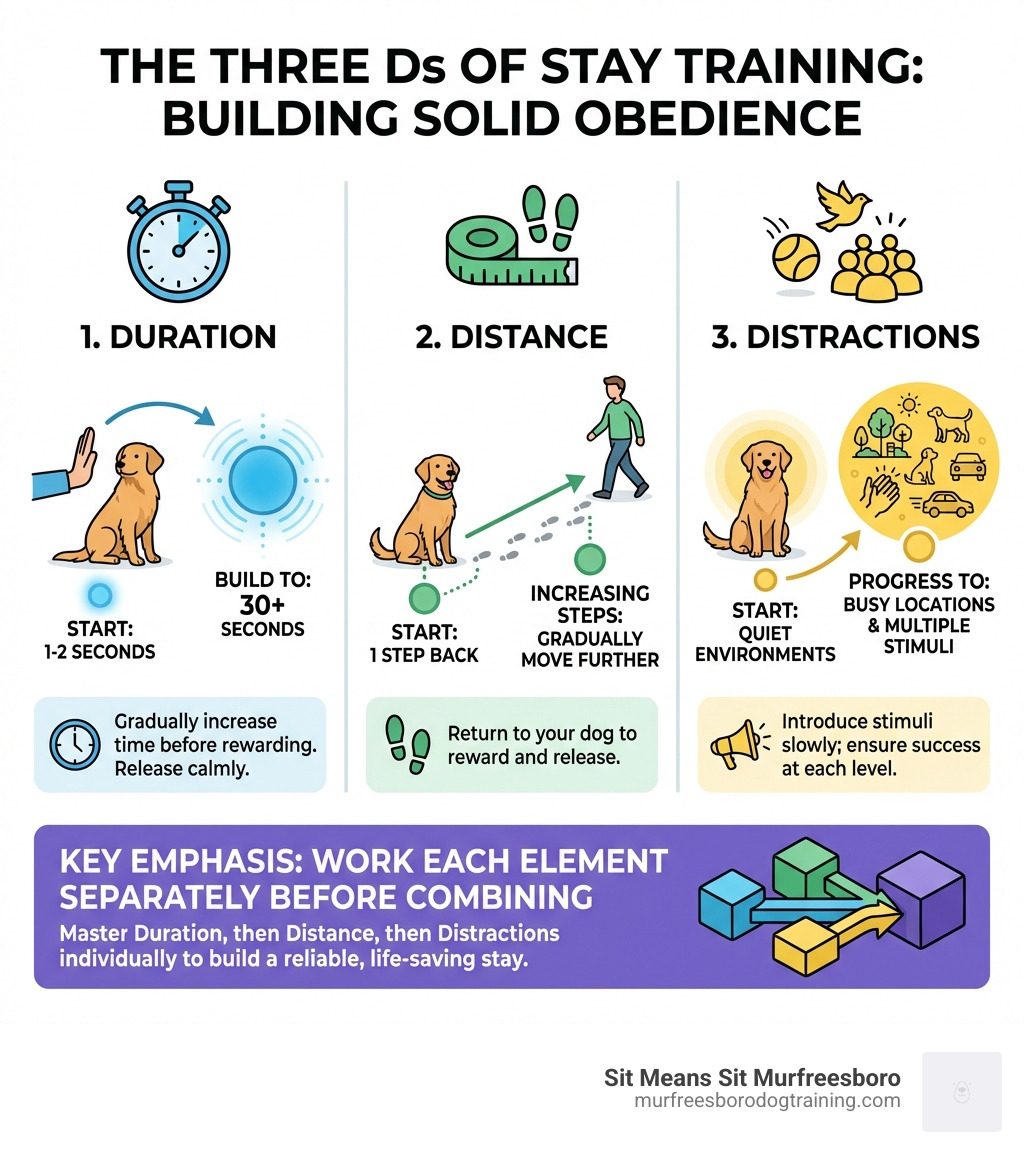
Once your dog understands the basic concept, it’s time to “proof” the command using the Three Ds: Duration, Distance, and Distraction.
1. Duration (The “How Long”)
Build up the time your dog stays still. Once they can handle 10 seconds, start making the timing unpredictable. Sometimes reward after 5 seconds, sometimes after 15. This prevents the dog from “counting down” to their release. Aim for a solid 30-second stay before moving to the next D.
2. Distance (The “How Far”)
After your dog is a duration pro, start adding distance.
- Say “Stay,” take one small step back, then immediately step back to your dog to reward them.
- Pro Tip: Always return to your dog in the early stages. If you always call them to you, they will start to anticipate the “come” command and break their stay early.
- Gradually increase to two steps, then five, eventually working up to leaving the room entirely.
3. Distraction (The “What’s Happening”)
This is the hardest part. Distractions can be anything from you clapping your hands to someone ringing the doorbell.
- Start small: Wave your arms, bounce a ball nearby, or knock on a table.
- If your dog breaks the stay, it means the distraction was too high. Go back a step and try a “smaller” distraction.
- Eventually, practice in your backyard or a local park in Walterhill to generalize the behavior.
For a deeper dive into these mechanics, you can read Dog Training: How to Teach a Dog to Stay. You might also find our how-to-teach-your-dog-to-heel-a-complete-training-guide helpful as you build out your dog’s obedience repertoire.
Frequently Asked Questions about Stay Training
How long does it typically take to teach a reliable stay?
Most dogs can learn the basic concept of “stay” within one or two 10-minute sessions. However, achieving “real-world reliability”—where your dog stays put even when a cat runs by or a guest enters your Lascassas home—takes weeks of consistent practice. It’s a marathon, not a sprint!
What should I do if my dog breaks their stay?
Stay calm! Do not scold or punish your dog. Punishment often makes dogs insecure, which leads to more mistakes. Simply lead them back to the original spot, ask for the sit or down again, and try a “mini” version of the stay (shorter time or less distance) to ensure they succeed. Always end on a positive note.
Are there different types of stay commands like sit-stay or down-stay?
Yes! A sit-stay is great for quick situations, like waiting for you to clip on a leash. A down-stay is more stable and is better for longer durations, like when you’re eating dinner or grooming your pup. Some owners even teach a stand-stay, which is incredibly helpful during vet examinations. We recommend practicing all three to make your dog a well-rounded companion.
Conclusion
Teaching your dog to stay is one of the most rewarding investments you can make in your relationship with your pet. It builds trust, ensures safety, and creates a calmer household. Whether you’re navigating the busy streets of Murfreesboro or enjoying a quiet afternoon in Rockvale, a reliable stay command gives you peace of mind.
At Sit Means Sit Murfreesboro, we specialize in changing dogs into confident, obedient companions through personalized training. We focus on real-world reliability—training your dog to listen not just in the living room, but in the middle of a park with distractions everywhere. From addressing complex behavioral issues to providing ongoing support for owners across Rutherford County, our mission is to ensure a better life for both you and your furry friend.
Ready to take your training to the next level? More info about training programs is just a click away. Let’s work together to make your dog the best they can be!