
Why Teaching Your Dog to Settle Changes Everything
Teach dog to settle and you’ll open up one of the most valuable skills your companion can learn. If your dog runs in circles like the Tasmanian Devil, can’t calm down when guests arrive, or struggles to relax even after exercise, settle training is the answer.
Quick Guide: How to Teach Your Dog to Settle
- Start in a quiet space with your dog on leash and a comfortable mat or blanket
- Sit calmly and ignore your dog until they naturally lie down (no commands needed)
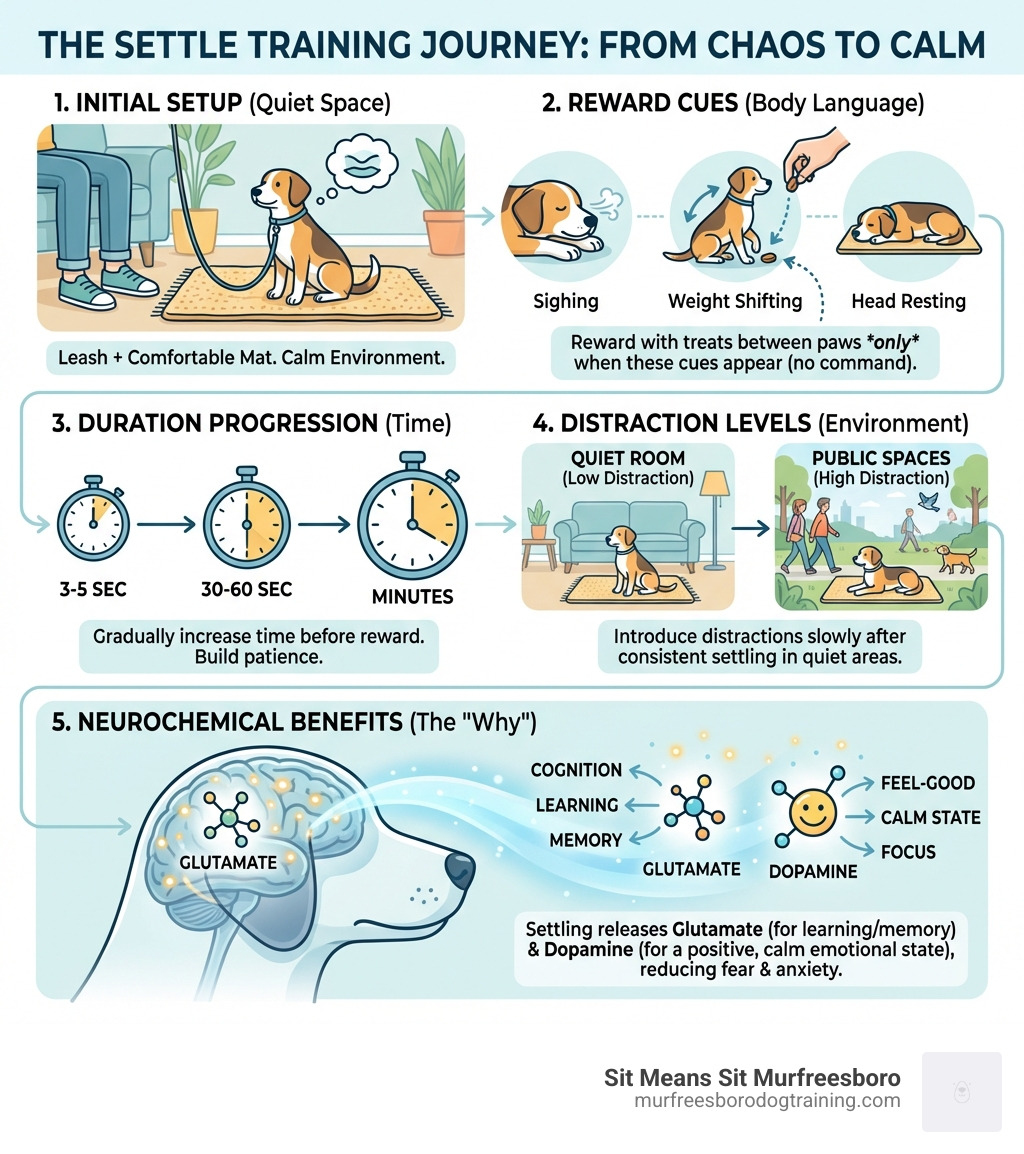
- Reward relaxed behaviors like sighing, weight shifting, or head resting with treats placed between their paws
- Gradually increase duration before rewarding, building from 3-5 seconds to several minutes
- Introduce distractions slowly once your dog settles consistently in quiet environments
- Practice in different locations to generalize the behavior everywhere you go
Settle training isn’t just about stopping unwanted behavior. It allows glutamate (linked to brain development, cognition, learning, and memory) to rise in your dog’s brain while releasing dopamine, which makes them feel genuinely good. Many behavior problems stem from fear, anxiety, or excessive arousal, and retraining can’t begin until your dog achieves a calm, relaxed state on cue.
The settle command saves dogs from isolation in backyards, crates, or separate rooms. It helps you actually enjoy your dog instead of managing constant chaos. Whether you’re dealing with excitement at greetings, anxiety when you prepare to leave, or inability to relax during dinner, teaching settle gives both you and your dog the peaceful moments you both need.
I’m Stephen Sovenyhazy, and while my primary expertise is in digital marketing and platform engineering, I’ve worked closely with service-based businesses like Sit Means Sit Murfreesboro to help dog owners find effective training solutions that address real behavioral challenges. Understanding how to teach dog to settle is fundamental to creating the calm, confident companion you’ve been hoping for.
What Does it Mean to Teach Dog to Settle?
When we talk about the “settle” command, we are looking for something much deeper than a simple “stay.” At Sit Means Sit Murfreesboro, we define a settle as a dog’s ability to find their own “off-switch.” It is an internal emotional state of relaxation rather than just a rigid physical posture.
While a “Down-Stay” is a formal command where the dog must maintain a specific position (like a sphinx) until released, a “Settle” is a request for the dog to relax. If they want to shift their weight, roll onto their hip, or rest their chin on their paws, they are welcome to do so. In fact, we encourage it!
| Feature | Settle Command | Down-Stay Command |
|---|---|---|
| Primary Goal | Emotional relaxation | Physical stationary position |
| Body Language | Loose muscles, sighing, head down | Alert, focused on the owner |
| Flexibility | Dog can shift positions | Dog must remain in a strict “down” |
| Mental State | “I’m chilling out” | “I’m working/waiting for a cue” |
| Duration | Can last 30+ minutes | Usually shorter, high-focus bursts |
To teach dog to settle effectively, we focus on the dog’s physiology. According to research on canine relaxation, the goal is to shift the dog from a state of high arousal (heart racing, scanning the room) to a state of parasympathetic recovery. This isn’t just a trick; it’s a biological shift that helps your dog process information and manage stress in Rutherford County’s busy environments.
Why Settle Training is Essential for Your Dog’s Well-being
We often see owners in Smyrna and Murfreesboro who feel like they have to constantly entertain their dogs to keep them from being “bad.” However, a dog that never learns to be bored is a dog that is constantly stressed.
The Science of Calm
The benefits of settle training are backed by neurochemistry. When a dog is allowed the time and space to settle, levels of Glutamate rise. Glutamate is a neurotransmitter linked with brain development, cognition, and memory. By teaching your dog to relax, you are actually making them smarter and more capable of learning other tasks.
Furthermore, the release of Dopamine during these calm periods ensures your dog feels good about being still. It transforms “doing nothing” from a chore into a rewarding experience.
Real-World Benefits
Teaching this skill provides several life-changing benefits for families in Middle Tennessee:
- Anxiety Reduction: It gives anxious dogs a “safe” behavior to perform when they feel overwhelmed.
- Social Inclusion: A dog that can settle under a table at a cafe or next to the couch during a movie is a dog that gets to go more places.
- Greeting Manners: Instead of jumping on guests, your dog learns that the fastest way to get attention (eventually) is to lie down quietly.
- Preventing Isolation: Many dogs end up relegated to a crate or the backyard because they are “too much” in the house. Settle training brings them back into the family circle.
If you are looking for more ways to integrate these skills into your daily life, check out our training programs designed for real-world reliability.
Preparing Your Dog for Success
Before we dive into the “how-to,” we need to ensure your dog is actually capable of settling. You can’t expect a Border Collie that hasn’t moved all day to suddenly become a rug.
- Meet Basic Needs: Ensure your dog has had appropriate physical exercise and mental stimulation for their breed and age. A tired dog is a much better student for settle training.
- The Right Environment: Start in a quiet room in your home—perhaps a spot in Walterhill where there isn’t much foot traffic.
- High-Value Rewards: You’ll need 20-30 small, pea-sized treats. Think boiled chicken or small bits of cheese.
- Your Demeanor: This is the most important tool! If you are excited, loud, or frustrated, your dog will mirror that energy. We use a soft-spoken, calm tone and slow movements.
How to Teach Dog to Settle: The “Do Nothing” Method
This is our favorite way to start because it teaches the dog to choose calmness rather than being forced into it.
- Step 1: The Tether. Put your dog on a 4-to-6-foot leash. Sit in a chair and either step on the leash (leaving about 12-15 inches of slack) or hold it firmly. Your dog should have enough room to stand, sit, or lie down, but not enough to wander off or jump on you.
- Step 2: The Silent Treatment. Ignore your dog. Don’t talk to them, don’t look at them, and definitely don’t give them commands like “Sit” or “Down.” Let them pester, whine, or pull for a moment.
- Step 3: Catch the Calm. The moment your dog chooses to lie down—even if it’s out of boredom—calmly drop a treat between their front paws.
- Step 4: Reward the “Sigh.” Look for deeper signs of relaxation. Did they shift their weight to one side? Did they let out a long sigh? Did they rest their chin on the floor? These are the “Gold Medal” behaviors. Reward them immediately but quietly.
- Step 5: The Release. Use a consistent word like “Free” or “Okay” to let them know the session is over.
Steps to Teach Dog to Settle with Distractions
Once your dog is a pro at settling in your living room, it’s time to take the show on the road. We want a dog that can settle even when life is happening around them.
- Duration Building: Don’t just reward the moment they hit the floor. Wait 3 seconds, then 5, then 10. Gradually work up to several minutes of “doing nothing” before they get a treat.
- Distance: Start moving your chair further away from the mat or the tether point.
- The Helper Distraction: Have a family member walk through the room. If your dog stays settled, reward! If they get up, simply wait for them to settle again before rewarding.
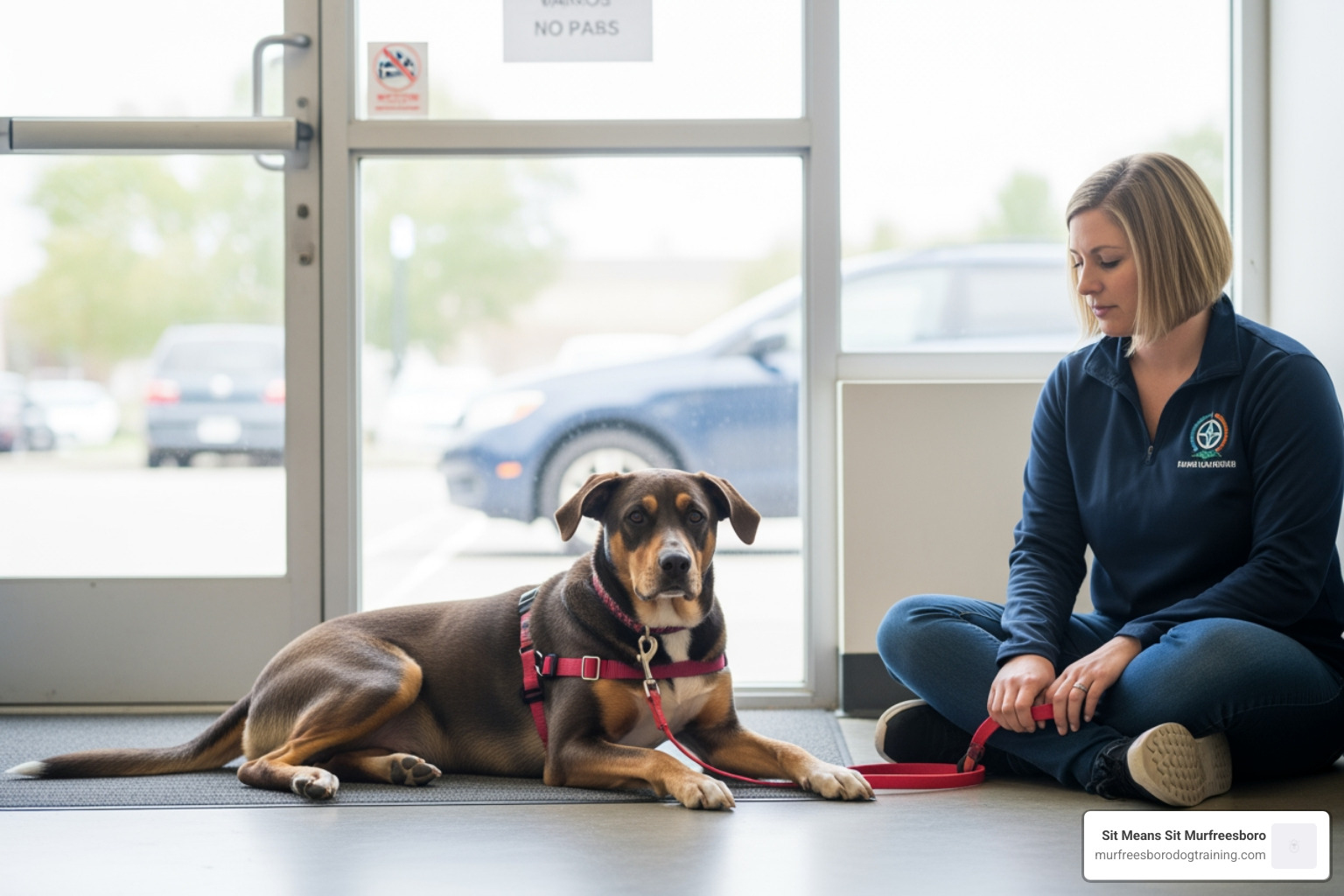
- Public Places: Take your training to a park in Christiana or a dog-friendly shop in Rockvale. Use the same leash-stepping technique. The goal is for the dog to realize that “Settle” applies everywhere, not just at home.
Advanced Methods: Mats and Games
For many dogs, having a physical “target” makes settling much easier. This is where the “Go to Mat” command comes in.
Go to Mat
- Place a specific mat or towel on the floor.
- Reward your dog for any interest in the mat (looking at it, stepping on it).
- Lure them into a “Down” on the mat.
- Once they are consistently lying on it, add your cue word: “Settle” or “Mat.”
- Eventually, you should be able to point to the mat from across the room and have your dog go there and relax.
Coaching Calm Game
This is a variation where we reward the dog for “checking out” of a situation. If you are playing with a toy and then stop, reward the dog the second they stop franticly looking for the toy and instead look away or sniff the ground. We are coaching them to transition from “high gear” to “neutral” quickly.
The Touching Game
Many dogs struggle to settle because they are sensitive to touch or handling. While your dog is in a settled position, gently pet them or touch their paws. If they remain relaxed, give them a treat. This is foundational for stress-free vet visits and grooming sessions.
Variable Reinforcement and Phasing Out Clickers
In the beginning, we reward every single calm behavior (Continuous Reinforcement). Once your dog understands the game, switch to a Variable Schedule—rewarding every second or third sigh. This makes the behavior more durable. If you use a clicker to mark the “down,” start phasing it out in favor of a calm “Good” so the sharp “click” doesn’t accidentally rev the dog back up.
Troubleshooting When You Teach Dog to Settle
Training isn’t always a straight line. If you hit a snag, look at these common issues:
- Regression: If your dog was settling for 10 minutes and now can’t do 10 seconds, you’ve likely progressed too fast. Go back to a quiet room and shorter durations.
- Body Language Cues: If your dog is lying down but their ears are pinned, their eyes are wide (whale eye), or they are panting heavily, they aren’t “settled”—they are “suppressed.” They are still stressed inside. Wait for a physical softening before rewarding.
- Overtiredness: Just like toddlers, overtired puppies can become “land sharks” and lose the ability to settle. If they are frantic, they may need a forced nap in a quiet crate.
- Regression in Public: If your dog can’t settle at a park in Lascassas, you might be too close to a distraction (like a squirrel or another dog). Increase your distance until they can find their brain again.
Frequently Asked Questions about Settle Training
What is the difference between a ‘settle’ and a ‘down-stay’?
As mentioned in our table earlier, a “down-stay” is a formal work command. A “settle” is an invitation to relax. In a down-stay, the dog is waiting for the next command. In a settle, the dog is learning to simply exist in a calm state without needing a job to do.
How long should training sessions be and how often?
For puppies under six months, keep sessions to 2-5 minutes, 2-3 times a day. For adult dogs, you can work up to 10-15 minute sessions. The goal is frequency over duration—practicing three times a day for five minutes is much better than one 30-minute session once a week.
At what age can I start teaching my dog to settle?
Right away! Puppies as young as 8-10 weeks can start learning the “Do Nothing” game. In fact, teaching a puppy to settle is the best way to prevent separation anxiety and destructive chewing later in life.
Conclusion
Teaching your dog to settle is perhaps the greatest gift you can give them. It provides them with the tools to steer a loud, fast-moving world without fear or overstimulation. At Sit Means Sit Murfreesboro, we specialize in this kind of real-world reliability. We don’t just want your dog to perform tricks in a quiet room; we want them to be confident companions who can hang out with you at a backyard BBQ in Rutherford County or stay calm during a thunderstorm.
Our personalized training programs address complex behavioral issues by focusing on the bond between you and your dog. With our ongoing support, you won’t just “fix” a problem—you’ll transform your lifestyle.
Ready to see the difference a calm dog can make? Start your journey with our training programs today and turn your “Tasmanian Devil” into a relaxed, obedient best friend.